Thursday, August 14, 2014

The Right Tools for Catch and Release Musky Fishing

In my opinion, muskies are a special kind of fish.  They get huge, they're toothy, fast as heck, hit hard, fight hard, and are just plain mean and beautiful at the same time.  Therefore, it's up to us to honor them by releasing them cleanly.  And guess what?  Like anything else, there's a right way to do it.  To release muskies properly, you need the right tools for the job to maximize their chances of survival.
Catching muskies are very cool, and if you want to keep catching them, clean releases are crucial for their survival.  You need to be prepared with the right tools for the job.
1)  The Proper Net:  First and foremost, you need the right net for the job, and that requires an over-sized hoop and bag.  I purchased the Beckman Fin Saver Pen Net.  I also purchased the net cover for storage purposes.  With the net cover on, it kind of looks like King Kong's ping pong paddle.  This particular net has a hoop diameter of 34 inches and the bag is 40 inches deep.  Why such a large net?

Beckman's website states, "Pen Fin Savers are stout “bigger fish” nets with all the Pen Series anti-tangle attributes and a practical array of hoop/bag/handle options. But they’re especially release-friendly, with smaller knotless treated mesh for a more caring and gentler contact with the fish. With a Fin Saver there’s less mesh-snarling of teeth, fins, and gill plates. Today’s trophy angler requires a rugged right-sized net for landing large fish — as well as a fish-friendly net bag for the most lively releases!"

There are other brands too that work equally well, including the Frabill Conservation Series net and the largest Stowmaster net.  These nets allow for you to remove the hooks while keeping the fish alive and well in the water.
Catching fish like this one caught by my musky fishing friend, Ed, require a much larger net than used for other types of freshwater fishing to ensure a clean release.  Photo courtesy of Ed Lewandoski.

2) Jaw Spreader:  Jaw spreaders are simple wire like devices that are under tension by design, and when you separate the arms it opens up spreading the jaws of the musky wide enough that you can safely remove hooks without getting bitten.

3) Hook Cutter:  You can buy hook cutters from fishing companies, or purchase a bolt cutter from your hardware store.  I use a Knipex 8 inch compact bolt cutter with lever action.  These are always reliable and work really well.  Obviously, you'll need to stock up on spare hooks.  Muskies will often inhale your lure, and trying to remove deeply hooked fish is harmful to the fish, and cutting the hooks really helps their survival chances and a quick clean release of your fish.  The hooks are pretty cheap compared to how often you'd need to do this.  After cutting the hooks and removing the lure, remove the hooks pieces with your long nose pliers to further protect the fish.

4)  Hook-Out:  I use the Tyrant Tackle Hook-out.  There are other brands, but I liked this one because I can also use it to retrieve lures that have fallen to the bottom of my musky tackle box, saving me arm punctures if I had to reach in there pick the lure out that fell.  But the real purpose of this is to reach in and poke a hook free if it's easy to get to.

5)  Extra Large Longnose Pliers:  These also work well for removing hooks, especially when they are not hooked deep.  You can easily provide leverage against the hook and remove that hook without getting bitten.  You can buy these from musky tackle sites, like Musky Tackle Online, or purchase them from a hardware store.  I prefer stainless steel or something that doesn't rust easily.  You can buy some of the other products above from MTO as well.
The tools of the trade include gloves, and top to bottom, large longnose pliers, hookout, jawspreader, and hook cutters (bolt cutters).  These tools will increase the odds that the muskies that you catch and release will survive.
The above tools are necessary to protect the fish and ensure a clean release.  Now, let's discuss some other release tools that you might find useful to not only release your fish, but to protect you or allow you to take a measurement or handle your fish safely.

6)  Gloves:  There are several styles of gloves on the market, some providing more protection than others.  I probably would buy the Lindy Joe glove but my hands don't fit in those gloves well, so I purchased some of the cheaper fishing gloves from Bass Pro Shops with the rubber coated fingers and palms.  These are more for your protection than the fish, because when you lift the fish out of the net for a picture, measurement and release, your fingers might be exposed to the extra sharp gill rakers that can easily cut your fingers wide open.
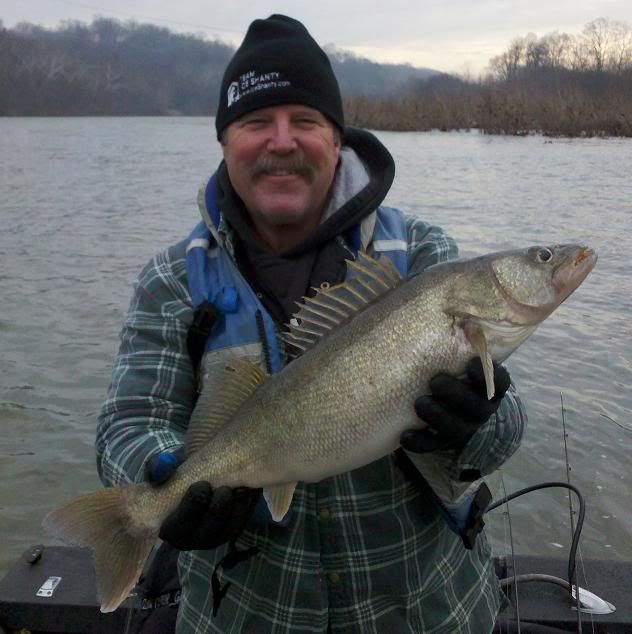
Even smaller muskies like this one can cut your fingers wide open with those gill rakers.  Gloves will help protect your fingers and hands.  Photo courtesy of Ed Lewandoski.
7)  Bump Board:  Bump boards are designed to help you to control your fish from flopping around so that you can quickly measure your fish.  I currently don't own one of these, but plan to purchase one soon.  I use a measuring tape to measure my fish.  You could also place markings on your boat deck to do this.  The bump board is the safest way for the fish though.
Bump boards like this allow you to easily and accurately measure your musky while keeping your fish under control and not flopping around on your boat deck.  Obviously, this helps to protect the fish.  Photo courtesy of Ed Lewandoski.
8)  Split Ring Pliers:  These will help you replace your hooks after your release and allow you to continue using your hot lure by spreading the split ring making hook attachment quick and easy .

Once you've removed the hooks from your fish, care should be taken to hold your musky properly when removing them from the net and also while photographing them.  The following link provides the correct way to handle muskies complete with photographic examples:
How to Properly Hold a Musky for a Photo Op

The Conservation section of that website also contains other valuable information about caring for your musky.  If you are seriously interested in joining this musky addiction, then I encourage you to read the other conservation pages on the Mid-Atlantic Muskies website.  There is quite a bit of info on there that I didn't cover.
After removing your lure, measuring and photographing your fish, take your time to make sure that the fish fully recovers.  My fishing buddy Shawn recommends rocking the musky from side to side rather than pushing the fish through the water lengthwise.  
Some people like to use a boga grip to handle muskies.  But one Conservation Officer in my state showed us pictures of fish with broken jaws that probably resulted from someone using a boga grip, and lost control of the fish.  Muskies are very strong and can easily break their own jaw by twisting.  If you must use a boga grip, use a quality one with the swiveling head that allows for some give when the fish moves it's head, and also make sure that you support the fish by the tail or under the belly to keep the weight off the jaw.

One quick note about photographing your catch.  Your photos will look much better if you remove your sunglasses.  This is true when taking any fishing picture, but it's easy to forget to take them off during the hectic moments from the time you bring your musky to the net until it's time to release them.  My concern for the fish often causes me to hurry the picture taking process, and that's usually why I forget to take them off.
Don't forget to take your sunglasses off  when taking a picture of your catch.  I forgot to do that in this picture which would have looked much better had I taken the doggone things off.
If you're interested in catching muskies, or catch them once in a while and don't know much about them, I hope that you found this post useful.  Thank you for taking the time to read it.  I wish you the best in the clean release of your next personal best musky!

Fish All Day for One Bite?

March 2012

Doesn't sound very productive, does it?  Many have written about musky being the fish of 10,000 casts, including me.  But even if it was only 10,000 casts, tossing lures that weigh as much as my cat all day long will make that 9,999th cast an act of torture.  My signature on a local musky forum now reads, "You know what's amazing about musky fishing?  You cast your butt off all day long, to the point of physical exhaustion, and, in a matter of seconds, one measly bite either makes your day or sends you home skunked."

Ain't it the truth?

I fished hard the other day and my shoulders simply ache...still.  Where is my bottle of Advil?  Is it worth it, such pain, for one fish or maybe two if you're lucky?  Most anglers would not think so, but there are some hard core musky anglers out there that will tell you that it most certainly is.

And I agree.
I wound up nearly pushing the limits on my rotator cuff tossing huge lures all day for what?  My personal best musky, 39.5 inches long, that's what!  Was it worth it?  Heck yeah!
I lobbed a heavy glider and other huge lures all day long.  When they hit the water with a huge splat upon a cast, other nearby anglers were ducking for cover, wondering if the sky was falling.  How many of you can state that they've tossed lures that actually create a wake when they land?  Or, would a better term be a Tsunami?

Gliders are somewhat like subsurface Zara Spooks, that, with twitches of the rod tip, alternating with half reel cranks, creating a series of pulls on the lure combined with alternate periods of slack line that basically send the lure into a zig-zag retrieve.  If the lure is as big as my cat, you can imagine that even that takes a toll on your musculature, much less casting the daggone things.
Gliders, like these made by Tony Ashby, are great for triggering aggressive musky strikes.  Be ready at all times for that one bite.
I did raise one fish earlier in the day, one that rolled on my glider but missed.  Any action gives you confidence and keeps you going.  It's actually almost heart stopping at times.

Here's the deal though; you may cast for hours on end, maybe days, without a single a follow or swirl.  But, you're fishing for that one fish, that one bite, and you'd better make it count when it happens.  You need to be ready at all times.  Then again, one fish isn't enough, because after I've released a caught fish, I'm stoked to catch another one.  Multiple musky days are awesome!

Ed Lewandoski shared an experience he had, "The trip in January 2010 that Ken and I made to the New River.  We drove five hours the night prior to fishing, and an equal distance to look forward to afterwards.  We only saw one fish, where Ken was able to hook, fight and boat his personal best at 45 inches and change.  It would have been a whole 'nuther ride if it wasn't for that fish!"

It pretty much sums it up.  You can't fall asleep and go through the motions.  You need to follow up on each cast, alert and in tune with what your lure is doing.  Finish the cast with a figure eight, or a wide sweeping "L", some sort of direction change to provoke a strike from a chasing musky.  Don't be lazy on anything.

As Ed notes on the topic, "Are you ready for that big fish on every cast?  Some folks just get tired and aren't ready on every cast and retrieve.  I guess it's a game of odds.  The higher the number of casts and retrieves you are totally set on will improve your odds.  If one random BIG fish is going to test you over ten trips, which retrieve will it be on?  Will it be there on the first twenty casts where you are so into it that nothing distracts you?  Or will it be in that eighth hour, after you have had zero action all day?  Or, will a fish show on the one retrieve where your body is out of position to set the hook properly?  Or, will she show when your rod is pointed in the wrong direction so if you do set the hook, you won't get much power out of it?"
Ed Lewandosky with his personal best 45 1/2 inch musky.  Fish like this might only give you one chance, so take advantage of it and make it count!  This fish was so sweet that I had to share it again with you!
You have a chance at the fish that could make or break your trip, or a fish of a lifetime, and all you may get is that one chance.  Don't blow it.

Not long after I wrote the first blog post on this site, I found a "hot fish".  This fish that boiled on one of my lures on one cast, striking but missing.  Then, a few casts later, he rolled on it twice.  Then, another cast later, he rolled on it again, missing, only to nail my lure a couple twitches later.  Having a "hot fish" keeps you on your toes.  Your adrenaline is high, and you're alert, ready for that strike.

But there are times that border on boring, as if you're simply beating the water with your log sized lures over the Dead Sea.  Those are the times that you need to be alert, so be ready to set that hook at any moment, properly.  the fish could strike at any time, on any given cast.  You need to be ready, to perform a figure eight to draw a strike possibly on each and every cast, and once you hook up, to fight the fish carefully and land it cleanly.  That feeding window could open at any time.

It's hard work, casting the big stuff all day long.  You don't want all of your efforts to go for not, do you?    Now really, I'm only a rookie at this musky thing, so I have yet to experience the dejected feeling that you'd get when missing your only chance on the day, but I'm sure that I will.  After all, I'm human.  I can tell you, because of my own drive to fend off the skunk monster, the very one that I detest more than anything while fishing, that I can imagine how I'd feel if that happened to me.  I'll try and learn from other people's lessons rather than learn the hard way.

You may only get one chance.  And when you do, and it pays off, it's well worth it.  And it could turn your trip from one to forget to one that you'll never forget.

Tuesday, August 12, 2014

My Musky Addiction

Esox masquinongy, or muskellunge, affectionately known as musky or muskie, often seems like mythological creature to many anglers.  After all, it's also known as the fish of ten thousand casts.  I've only caught a few of them over the years, mostly by accident while fishing for bass or walleye.  Although I've always been fascinated by these magnificent predators, it wasn't until recently that my fascination turned into an infatuation, and even more recently, into an obsession.  And, I think that before long, it will be my next addiction.

One year, my buddies and I planned a trip to the French River in Ontario for a week, and I purchased my first musky rod and reel combination along with a few musky lures.  I didn't get a musky on that trip, but my friend Bob caught one that went about 54 inches long.  A few years later, my brother Kyle decided to target walleye and managed to catch several muskies.  He introduced me to that type of fishing, and that began my infatuation with muskies.  Until recently, we targeting other species and muskies were bonus fish, but our tactics didn't change.  We still fished smaller baits and lighter tackle because, quite frankly, we liked the action that bass and walleye gave us.  Walleye were on all of our minds at the time, but the toothy bigger muskies had my attention too.
My brother Kyle with a musky caught from shore while targeting walleye.  It's his fault I'm currently obsessed with musky fishing.
Can you target musky with that tackle?  Yes, but maybe the answer is that we shouldn't.  Catching them by accident is one thing, but targeting them with light tackle is another.  We owe these powerful fish a better chance at survival, and light tackle just isn't going to cut it.  They are not a particularly durable fish, and it's not worth wearing them out just because we can, and just because they will bite smaller baits.  If we use smaller lures to target these beautiful fish, they should be teamed with beefy enough tackle to bring them to the boat quickly and efficiently.

In the past, my lack of success catching size and numbers of musky directly resulted from two factors, logistics and tactics.  With regard to logistics, having access to good musky water is a huge benefit, and in my area having the right kind of boat makes a huge difference.  The first step is to identify the waters local to you that hold muskies and fish from a boat that is appropriate for that environment.

Another option would be to fish from the bank or wade.  Although it's possible to catch them this way, to be effective you'd have to fish prime musky holding water, and there aren't really that many good holes to go around.  There are some though, and savvy shore bound musky anglers have caught some dandy "skis".  Kayaks and other small craft can solve the access issue, and they catch their share of these mighty fish.  If you can find a kayak that allows you to stand, you'd be able to do figure eights, which are touch to do when seated.
My brother with a musky caught on a Rapala Husky Jerk while fishing for walleye from his kayak.
From my point of view, what prevented me from catching more of these fish was a flaw in my tactical approach.  The tactics that I used treated musky as a secondary target, and for me to be successful at catching them, I had to change my tactics.  When the logistics were right, I still brought tackle to fish for other species, ones that bite on smaller baits, like walleyes and bass.  I'd bring some musky tackle along, but rarely used that big stuff.   Why?  Lack of confidence mostly, and without confidence, your musky lures won't be in the water long enough.

I'd typically have good success fishing for bass or walleye, or whatever was biting.  Since those species have higher population densities, and often bite regularly, it was easier to be more successful targeting them.  Like many anglers, I hated getting skunked.  And that was the reason I didn't catch more musky on a regular basis.  To catch more musky, you need to risk getting skunked.  Let's face it, getting skunked is failure adn nobody wants that, not even dedicated musky anglers.  But, when a musky hits and you land it, that makes it all worthwhile.  A good day may consist of a follow or two, perhaps a hit, and even better, a fish to the boat.  Is it worth it?  I say it is.

That said, anything can happen.  My buddy Howard, while we were walleye fishing, hooked and landed two muskies in about five minutes on a Rapala Husky Jerk while fishing from the bank for walleye!  We were targeting walleye, quite unsuccessfully I might add, when these fish made his day.  Unfortunately, for me, I had a run in with the skunk monster.  Yet, those fish made a huge impression on me.  I wanted one, and I've been determined to become a real musky angler.  But this type of success also could lead one to believe that this is the most effective way to fish for them.  But again, it's not that we can't catch them using light tackle, the question remains, should we?  For the benefit of the fish, we should use tackle matched to ensure their survival.
My buddy Howard with one of two "twin" muskies caught on nearly back to back casts while fishing for walleyes from the bank.
When I started musky fishing a few years ago from my buddy's boat, I decided to dedicate trips targeting them, and left the smaller tackle at home.  If you only bring musky gear, and that's all you can toss, then your chances go up.  And mine did.  On my first trip out, I set out to catch a "lunge" and I did.  I forced myself to use the musky tackle, and it paid off.  So now, my confidence is much higher.  Success breeds success, right?
Not a huge musky, but one that caused my current obsession.  This fish engulfed a Musky Innovations Realfish in the sucker color.
I haven't had much experience fishing correctly for these fish.  And honestly, I hadn't researched it all that much.  On that trip, looking back, I did a lot of things wrong.  I didn't work the baits the right way, and I had some preconceived notions about these fish that just weren't the case.  I didn't realize that they were all that active on colder water, and how wrong that was.

On my next trip, I learned another valuable lesson.  When using large musky lures and heavy tackle, and even though my chances were much better to catch a musky, there's no guarantee that you'll catch one, or get a bite, or even get a follow, even though you're fishing prime water.  The trick is to obviously learn these fish, what they react to, and how to work your baits in such a way as to provoke a strike.  Going into both trips, I knew that these fish aren't easy to catch for a reason, and I risked getting skunked so that I could learn.

The real learned lesson was that sometimes your big lures catch big fish of other species.  My biggest walleye to date, my personal best, was caught on a twelve inch nine ounce lure!  The lesson was that big lures catch big fish, of all species, even those you aren't targeting.  Now, every bass angler is fully aware of that concept, but it's tough to imagine many fish hitting a twelve inch lure, but they do.  Many a musky angler could easily boast about catching huge largemouth, smallmouth or walleye, on musky tackle.
Using huge musky lures led me to catch my personal best walleye, a fat twenty six and a half incher, not a musky, but a heck of a consolation fish!
My buddy also learned a valuable lesson on our first trip, and believe me, I did too.  At one point, later in the day, we were fishing a spot that we had musky follows in the past.  We knew that muskies liked this spot, and we worked it thoroughly.  My buddy was using a Rapala Magnum X-Rap jerkbait, and had a musky follow it to the boat.  The musky stopped and sat there, staring at his lure that was still dangling in the water.  Had he moved it a foot more, it would have hit.  He's yelling, "Kevin, do you see that?  Do you see that?", as loud as he could yell, not hearing me simultaneously yelling back, "Figure eight!  Figure eight!".  By the time he heard me, the fish sank below the boat.  We tried desperately to raise that fish again, but to no avail.

So, the lesson he learned was to use the figure eight at the end of the cast.  The lesson that I learned was, to do it after each and every cast, not just when you see a musky follow.  Had I done that figure eight at the end of my cast, the musky may have seen my lure and hit it even though he had pulled his from the water.  That way, you can tag team these fish.  Now, I always do a figure eight or some other boat side maneuver.

I was watching Joe Bucher on the television yesterday, and he made a huge point about teaming up on these fish.  If the guy at the front is using one type of lure that draws a follow, often the guy in the back of the boat using a different lure, especially a bucktail, will get that following fish on a figure eight when the fish ignores the other guys lure after his figure eight.  These fish are not shy by any means.


Ed Lewandoski with a 45 1/2" beautiful musky.  You'd be hard pressed to find a more dedicated and knowledgeable amateur musky angler than Ed.  Photo courtesy of Ed Lewandoski.
So, what is all this about my addiction?  Is it the challenge, the fact that they are tough to catch?  Is it the fact that they are one mean toothy predator, and just plain cool to hold and to make for awesome photographs?  Or is it because you can chuck lures that weigh as much as the fish that most people catch and these apex predators will chomp on them readily?  I'm sure that as I grow in this segment of the fishing world, that my addiction will grow accordingly.

At fifteen to twenty dollars a pop, or more, amassing a collection of lures to target these things will be quite an investment, not to mention the other tackle and tools that I'd require.  That's an addiction all its own that I've fallen victim too, the tackle buying addiction, that is.  After all, I find it just plain cool to open up a package and pull out a lure that weighs about a pound.  I'm like a kid at Christmas!

At one time, I didn't have that many chances to be on the water chasing these magnificent creatures simply because I didn't own a boat and had to rely on my buddies that did.  Now that I own a boat, my logistics problem is partially solved.  The rest of the logistics problem centers around finding time to get out and away from the everyday things that keep me off the water, and to balance that time with other types of fishing that my fishing pals prefer.  But right now, all I think about now is solving the tactics problem.  I'm learning as much as I can about fishing strategies, on the internet, magazines, television shows, and fishing forums.  I've been fortunate to meet some great musky minds, like Ed, and have learned greatly from them.

Now that I've caught one while targeting them, I'm hooked.  I've had a good start, and have since caught quite a few (but never enough).  I'm excited about learning more and more about these amazing toothy mystical creatures.  And, as I learn more and my addiction grows, I'll share those adventures and things that I will learn along the way.  It's all I think about, all day, every day...